February 20, 2013
|
Managing supply chains | top
The current practice of managing supply chains
An article by Amir Schragenheim
It is Wednesday afternoon. I'm entering the grocery store and want to purchase some green peppers. However, they don’t have any on stock. I can’t find any good looking tomatoes either. I'm continuing to the Office Depot store. I heard great reviews about a new mouse that Microsoft issued and I would like to get one. However, I come to an empty shelf with only the item description stating "out of stock".
How many times did you go to a shoe store, tracked a wonderful pair of shoes you wanted to purchase but they didn’t have any in your size?
Why do stores don’t keep the right stocks to fulfill the demand? Why can't they do anything right?
Supply chains in our modern age operate in a way that seems to make a lot of sense. Manufacturers have robotic machinery to automate processes; many manufacturers operating nowadays have already installed new state-of-the-art ERP systems to help them manage their shop-floors.
Distributors and manufacturers have very sophisticated forecasting software to predict exactly how many items will be sold of each product or SKU (Stock Keeping Unit). Therefore, they should know how many units they would like to send the consumption points (retail stores) and when.
How is it that organizations still experience problems in managing the supply chains? Is technology not enough?
Click here to continue reading this article »
|
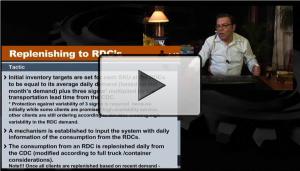
| Determining Inventory Targets |
(20 min) |
Goldratt presents and explains the strategy, tactics and corresponding assumptions for determining proper inventory targets, a critical piece for aligning production to actual demand when producing to availability. |
| |
|
|
|
A detailed yet practical approach for: | top
| Buffer sizing in projects |
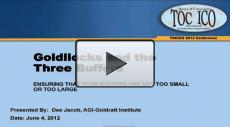
| Goldilocks and the Three Buffers |
(30 min) |
How do you know if your project buffer is the right size to immunize your project? This session covers the type of elements that can impact buffer sizing, task variability, iteration variability, known/ unknowns and risk, and it focuses on how to use traditional methods to tell if the buffer is too small or is appropriate given the variation at hand. |
| |
|
Project Management Systems Theory Taught Through Games
This article introduces three hands-on games that involve individuals in simple experiments that shift their understanding, highlight the solutions to these problems and allow them to teach others how to manage high performance projects.
|
| Using TOC in your Sales Process |
| The Cash Machine |
(37 min) |
This presentation is about Sales -its functional organization and management- as a process. It provides:
- Understanding the potential of TOC in a new area.
- Learning how to level sales assets usage along the entire year.
- Usage of sales data to point to constraints in the sales process.
|
| |
|
|
Theory of Constraints means FOCUS | top
WHERE
and HOW
to Focus? |
Learn where and how to focus when dealing with Production, Finance, Measurements, Project Management, Engineering, Distribution and Supply Chain, Marketing, Sales and Buy-in, Managing People and Strategy and Tactics. This SOLUTION will provide a holistic perspective and a focused approach for implementing the RIGHT changes and achieving IMMEDIATE results within an organization. |
|
New Book! WHERE IS THE CONSTRAINT? | top
[A Theory of Constraints Do-It-Yourself Toolkit - Kindle Edition]
By Henry Harel
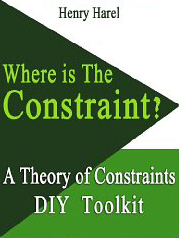  |
Do you want to boost your bottom line? This is the first step. A practical Do It Yourself guide to the implementation of the Theory Of Constraints (TOC), is brought to you. You can adopt the best operation management practices used by leading industries globally. You will learn how to find the problem in a variety of organizations, using explanations, basic rules and demonstrations. Use the knowledge of the organization you are in, combined with the powerful tools of TOC to embark on a continuous improvement process.
 |
|
|
|